
Demystifying Reading Instruction-a Structured Literacy Approach
When it comes to reading we hear so much terminology, lingo and about so many programs-Structured Literacy, Orton-Gillingham Method, Davis Method, Science of Reading, Wilson, Barton, EBLI-to name just a few. It can be extremely confusing and overwhelming as a parent trying to understand all the different educational lingo and navigate support for our students. Ultimately, our only goal as parents is to make sure our kids receive the best possible support and the best possible outcomes.
As an educator and the parent of a dyslexic child myself, the fact that structured literacy is rooted in decades of cognitive and neuroscientific research on how the human brain learns to read was the first indicator that this approach would make a difference for my child. Still, even with my professional background, it took years of personal research, professional development, and hands-on practice to truly master the subtle nuances of effective instruction for struggling learners.
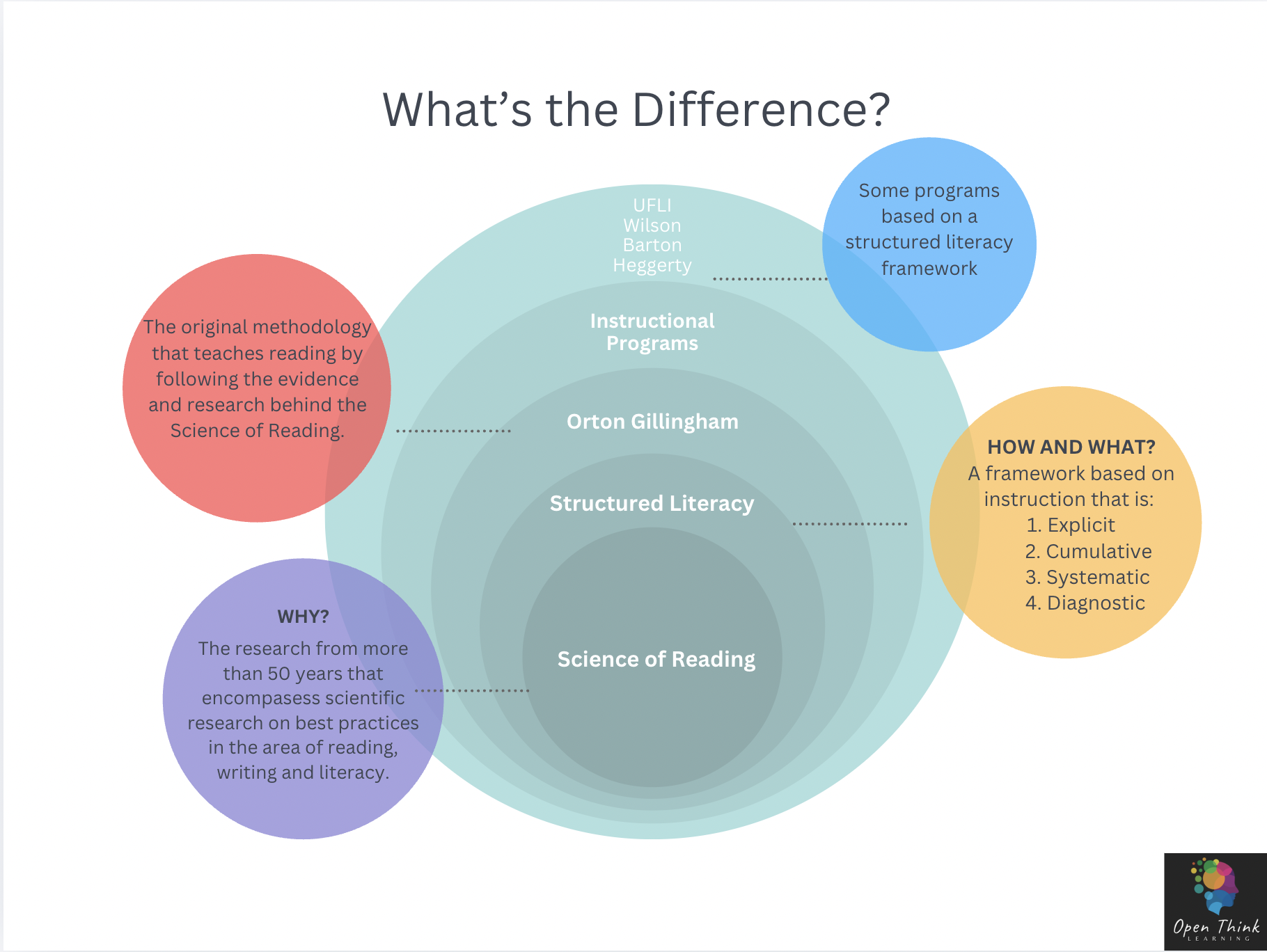
Here is a visual that can be helpful to understand some of the different elements of reading instruction:
I have a lot of parents come to me, trying to understand the best model for supporting their child and so I wanted to attempt to explain the essential elements of Structured Literacy, its core principles, and share why it makes such a difference for all learners, especially our dyslexic learners. I hope this information serves as a building block in your journey to understand the principles of reading instruction to ensure strong outcomes for your own student.
What Is Structured Literacy?
The focus of Structured Literacy is:
1. Explicit instruction where teachers clearly explain and model concepts rather than expecting students to simply absorb concepts indirectly.
2. Systematic instruction following a logical, well-defined scope and sequence that goes from simple to complex.
3. Cumulative to build on what was previously learned.
4. Diagnostic so that instruction is guided by careful assessment and flexible to allow for responsiveness based on what each child needs.
Unlike whole-language or balanced literacy approaches that encourage children to guess words from pictures or context, Structured Literacy teaches the structure of written language directly and comprehensively.
Structured Literacy targets these foundational components of language:
Phonology: The study of the sound system of spoken language, including phonemic awareness and manipulating individual sounds.
Sound-Symbol Association (Phonics): Mapping speech sounds (phonemes) to letters and spelling patterns (graphemes).
Syllables: Knowing syllable types and rules to decode multisyllabic words accurately.
Morphology: Studying the meaningful parts of words, such as roots, prefixes, and suffixes.
Syntax: Understanding sentence structure, grammar, and mechanics.
Semantics: Developing vocabulary and deep comprehension of meaning.
Using this framework, educators and interventionists are able to create lessons that are cumulative to build on what was previously learned and intermittently revisit past learning, interactive, and reinforced with multisensory strategies such as engaging visual models, lots of auditory support, and hands-on kinesthetic pathways.
As the instructor, it’s my goal to deliver clear, explicit direction, but the student must do the heavy lifting. By actively practicing skills through multiple sensory modalities and a strong evidence based framework, students internalize their learning to achieve true mastery. I often see students make gains of 1-2 years with only 5-8 months of intensive support. It’s amazing to watch a student’s confidence and ability grow as they engage with learning frameworks that allow for powerful results.
Why It Benefits Every Student
While Structured Literacy is essential for students with dyslexia or specific learning difficulties, research shows it significantly accelerates reading success for all children. Using a structured literacy framework, we can remove the guesswork for kids and build solid decoding and comprehension skills early. Seeing what a powerful difference this makes for the students I work with is why I’m so passionate about this work-every child deserves equitable access to strong literacy skills.
References:
Moats, Louisa, Ed.D. (2020) Structured Literacy: Effective Instruction for Students with Dyslexia and Related Reading Difficulties, International Dyslexia Association.
Ray, Jennifer S., Ph.D. (2020): Structured Literacy Supports All Learners: Students At-Risk of Literacy Acquisition – Dyslexia and English Learners, Texas Association for Literacy Education Yearbook, Volume 7: Leaping into Literacy